November 5, 2026
Democrats swept Congress, but the gambling story was in the states: a new Nevada governor, an iGaming-friendly winner in Ohio and defeats for online betting in Nebraska and casinos in Indiana.
The Democratic Party swept the key races in Tuesday's 2026 US midterm elections, winning control of both the Senate and the House of Representatives. For the gambling industry, the national result is unlikely to change much overnight. But a closer look at the state and local races shows a mixed picture: a new governor in Nevada, an iGaming-friendly governor in Ohio, a defeat for online betting in Nebraska and a string of local casino and wagering votes in Indiana and Virginia.
Congress: Democrats win control of both the Senate and the House
Nevada governor: Democrat Aaron Ford defeats incumbent Republican Joe Lombardo
Ohio governor: Democrat Amy Acton, who backs online casino legalisation with conditions, beats Vivek Ramaswamy
Nebraska: online wagering Measures 440 and 441 on course to fail, about 55% to 45%
Virginia: Pulaski rejects satellite pari-mutuel wagering; Amherst County too close to call
Indiana: Allen, DeKalb and Steuben counties all appear to reject an inland casino licence
Prediction markets: their future still looks more likely to be decided by the Supreme Court than by Congress
Little immediate change at national level
Control of Congress gives Democrats much more power to block President Trump's agenda for the rest of his term. For gambling, though, federal law has played a limited role since sports betting was left to the states in 2018, and the industry's biggest national question, the status of prediction markets, now looks more likely to be settled in court than in Congress, at least in the short term.
The medium-term picture is more interesting. Prediction markets have done well under the Trump administration. The Trump-appointed CFTC chair, Michael Selig, has given them broad regulatory room, a clear break from the more cautious approach of the Biden years. With Trump's approval rating very low and voters clearly frustrated with the Republican Party, a Democratic win in the 2028 presidential election could reverse that support. The sector has many legal battles already, as seen in the lawsuits spreading across New York, Kentucky, Nevada and New Mexico.
There is also a Supreme Court angle. With Democrats in control of the Senate, Trump would find it much harder to confirm a like-minded justice if Clarence Thomas or Samuel Alito were to retire before 2029. Florida governor Ron DeSantis wrote that the chances of "confirming a worthy successor" in that period are now virtually "zero". That could matter if the court takes up a case on the legality of sports event contracts.
Ironically, prediction markets themselves had a strong night: traders had priced a Democratic sweep as the most likely outcome, and they were right, as we reported in our look at the $1.48 billion midterm market.
Nevada: Aaron Ford unseats Joe Lombardo
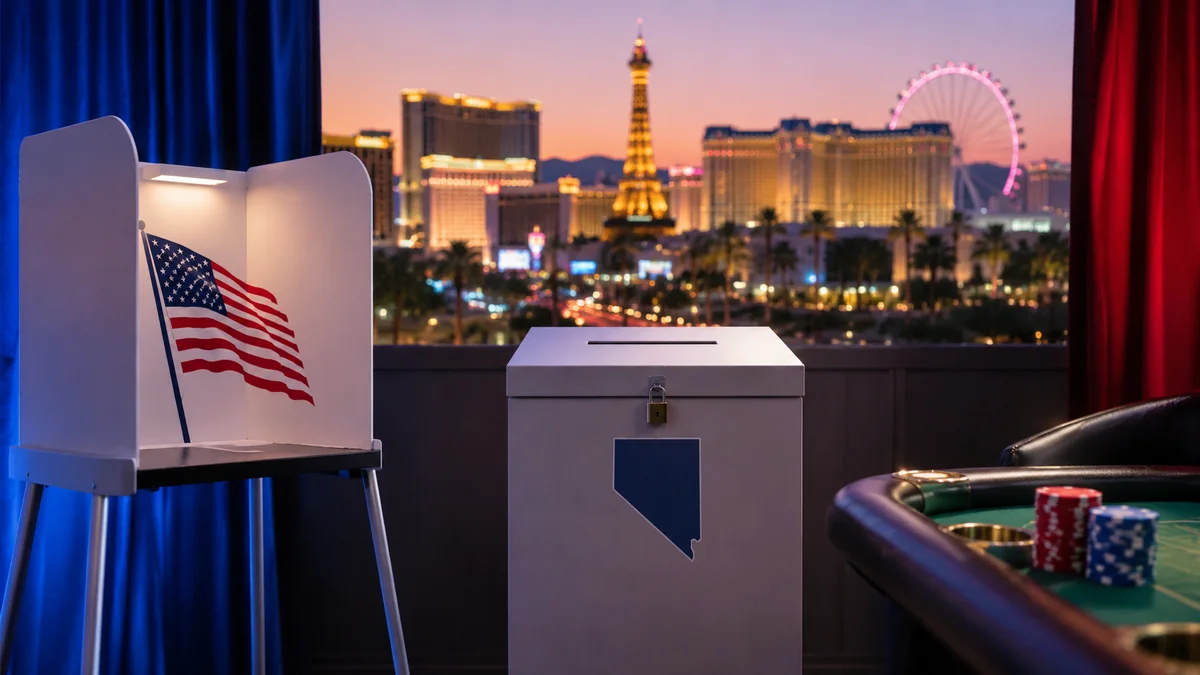
The most important result for the gambling industry came in Nevada, where Democrat Aaron Ford defeated Republican governor Joe Lombardo in a tight race. In the home of Las Vegas, the governor plays a direct role in the industry, including influence over gaming regulators and tax policy.
Lombardo was seen as the more business-friendly candidate. During the campaign he drew criticism for saying he needed to "take care" of the state's gaming billionaires because they create jobs. He also received millions of dollars from gaming-linked donors, including $3 million from Station Casinos, $2 million from the Fertitta family and $1 million from Las Vegas Sands. Ford, by contrast, had the backing of unions, including the hospitality unions that represent casino workers. We covered the money behind both campaigns ahead of the vote in our preview of the Nevada race.
Ford's win does not mean a hostile government for casinos. Gaming is Nevada's main industry and both parties depend on it. But a union-backed governor is likely to pay more attention to workers' pay and conditions, and casino companies that bet heavily on Lombardo will have to build new relationships in Carson City.
Ohio: an opening for online casinos?
In Ohio, Democrat Amy Acton beat Republican Vivek Ramaswamy in the race for governor. Acton has said she supports legalising online casinos, with conditions on player safety and advertising. Ohio already allows online and retail sports betting and land-based casinos, but online casino games remain illegal.
Ramaswamy had not taken a clear position on iGaming. The outgoing Republican governor, Mike DeWine, came out against it last year, arguing that the state had reached saturation after years of gambling expansion. Acton's win removes that opposition from the governor's office, but the path is still uncertain: Republicans control the state legislature, so any iGaming bill will depend on her ability to work across party lines.
Nebraska: online betting rejected
Nebraska voters were asked to approve online wagering through two linked ballot measures. Measure 440 would have authorised online betting through licensed racetracks and their operator partners, while Measure 441 would have made the legal changes needed for the state regulator to oversee it. Both had to pass.
With more than 95% of votes counted, Measure 440 was heading for defeat by about 55% to 45%, and Measure 441 was set to fail by a similar margin. The result is a setback for the state's racetracks and for operators hoping to enter a new market, and it shows that voters do not automatically back gambling expansion even where land-based betting is already established.
Virginia: one no, one too close to call
Virginia held two local votes on expanding physical wagering. In the town of Pulaski, a measure to allow pari-mutuel wagering at satellite facilities was rejected by 56.46% to 43.54%. In Amherst County, a similar measure was narrowly ahead at 50.66% to 49.34% with 92% of results reported, so the final outcome was still open.
Indiana: three counties say no to a casino
In Indiana, three counties, Allen, DeKalb and Steuben, asked voters whether they should be allowed to seek an inland casino licence. Only one licence was available, so even if all three had said yes, only one county could have won it. Official results had not been declared, but all three appeared to be rejecting the idea.
| Indiana county | Against | For |
|---|---|---|
| Allen | about 60% | about 40% |
| Steuben | about 59% | about 41% |
| DeKalb | about 65% | about 35% |
Local business groups had supported the project as a boost for the regional economy, while critics argued that a casino would harm local residents. The clear "no" votes in all three counties suggest that the economic argument did not convince most voters.
What it means for the industry
For casino operators in Nevada, the main task is adapting to a new governor who owes more to unions than to casino donors.
For iGaming operators, Ohio is now the state to watch. A governor who openly supports online casinos is a rare opportunity, although a Republican legislature means nothing will happen quickly.
For prediction markets, the election changes little today but adds risk for the future. Their strongest supporters are in the current administration, and voters have just sent a clear message against it.
And for anyone hoping to expand gambling through the ballot box, Nebraska, Pulaski and the three Indiana counties are a reminder that voters often say no, even in a year when gambling is more visible than ever.
Related reading
- Kamala Harris Heads to Las Vegas to Rally Culinary Union Behind Aaron Ford
- Poland's Gambling Paradox: Europe's Harshest Taxes, a State Monopoly and a Market That Keeps Growing Anyway
- ASIC Questions Whether Retail Prediction Markets Serve the Public Interest